Numeral
The countdown destroys. Counting things down yourself preserves.
A puzzle-platformer where the floor is made of numbers — and something is deleting them, one digit at a time, on a schedule that you can read.
Controls
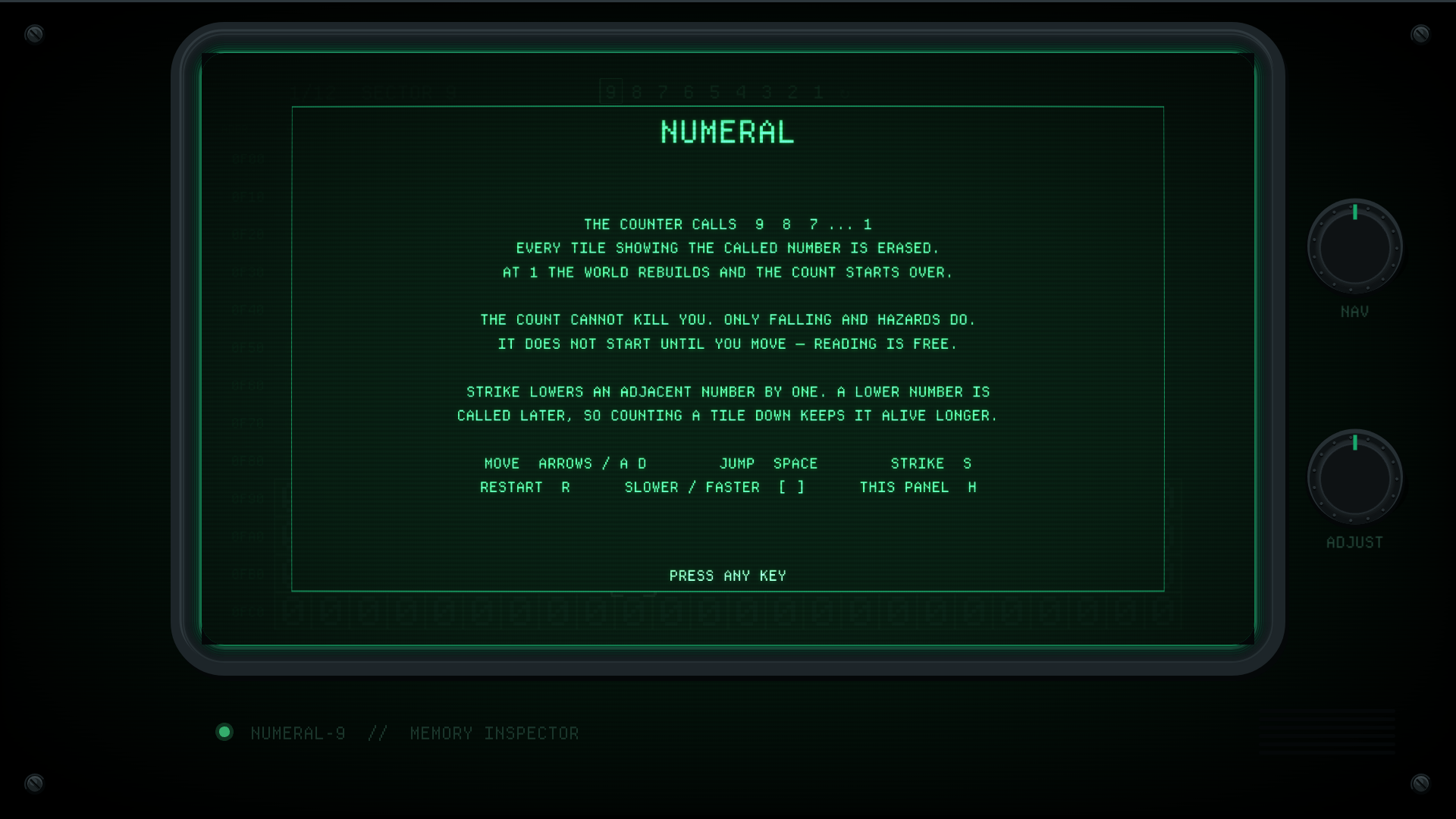
| Move | ← → or A D |
| Jump (hold for height, tap for a hop) | Space, ↑, or W |
| Strike — lower the highlighted tile by one | S, ↓, or J |
| Restart the level (instant) | R |
| Slow the count down / speed it back up | [ / ] |
| Show the controls again | H |
| Pause | Esc or P |
The count doesn't start until you move for the first time. Reading the room is free.
How To Play
- The floors are numbers. Every platform has a digit on it. Look at them before you move.
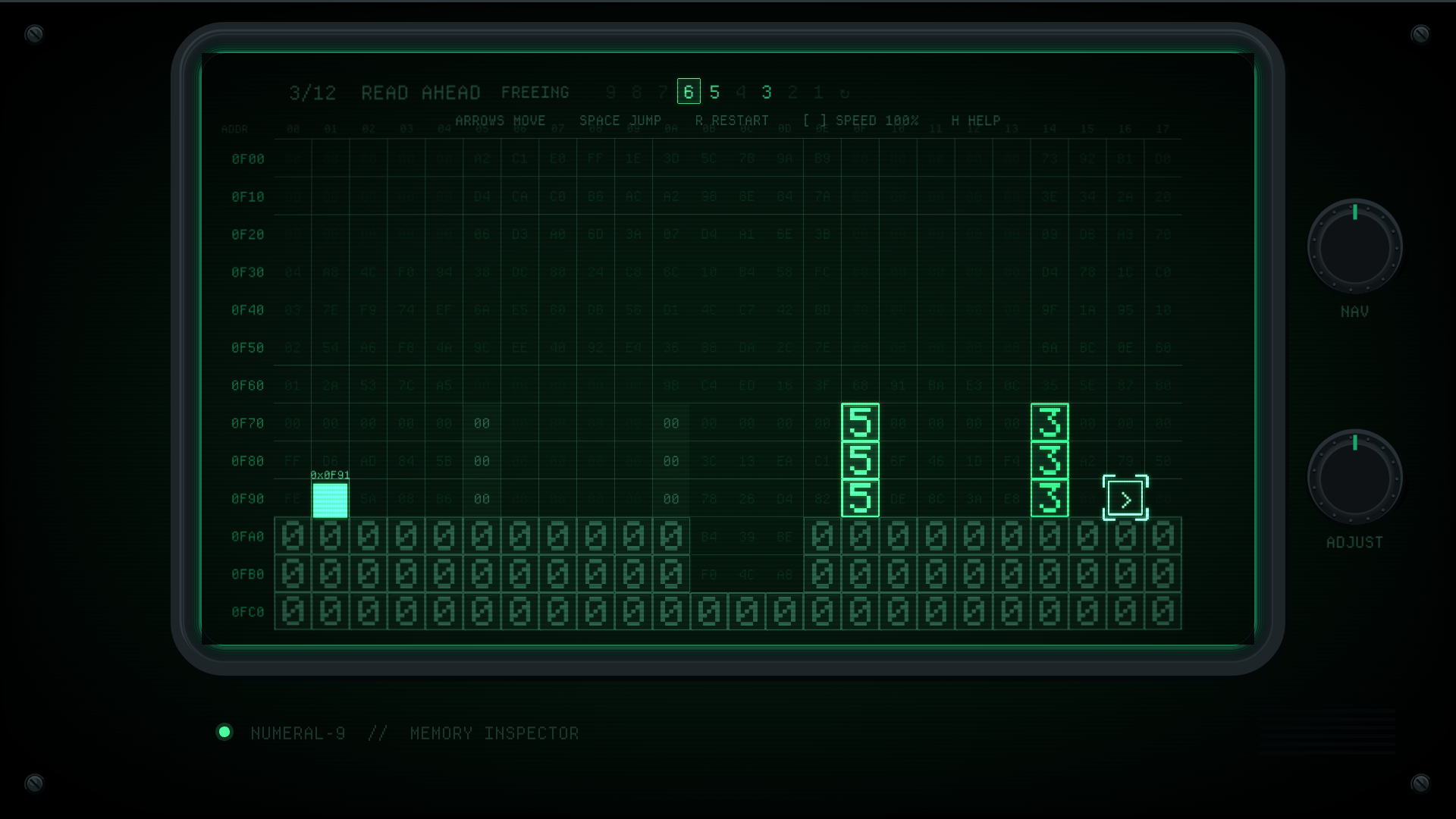
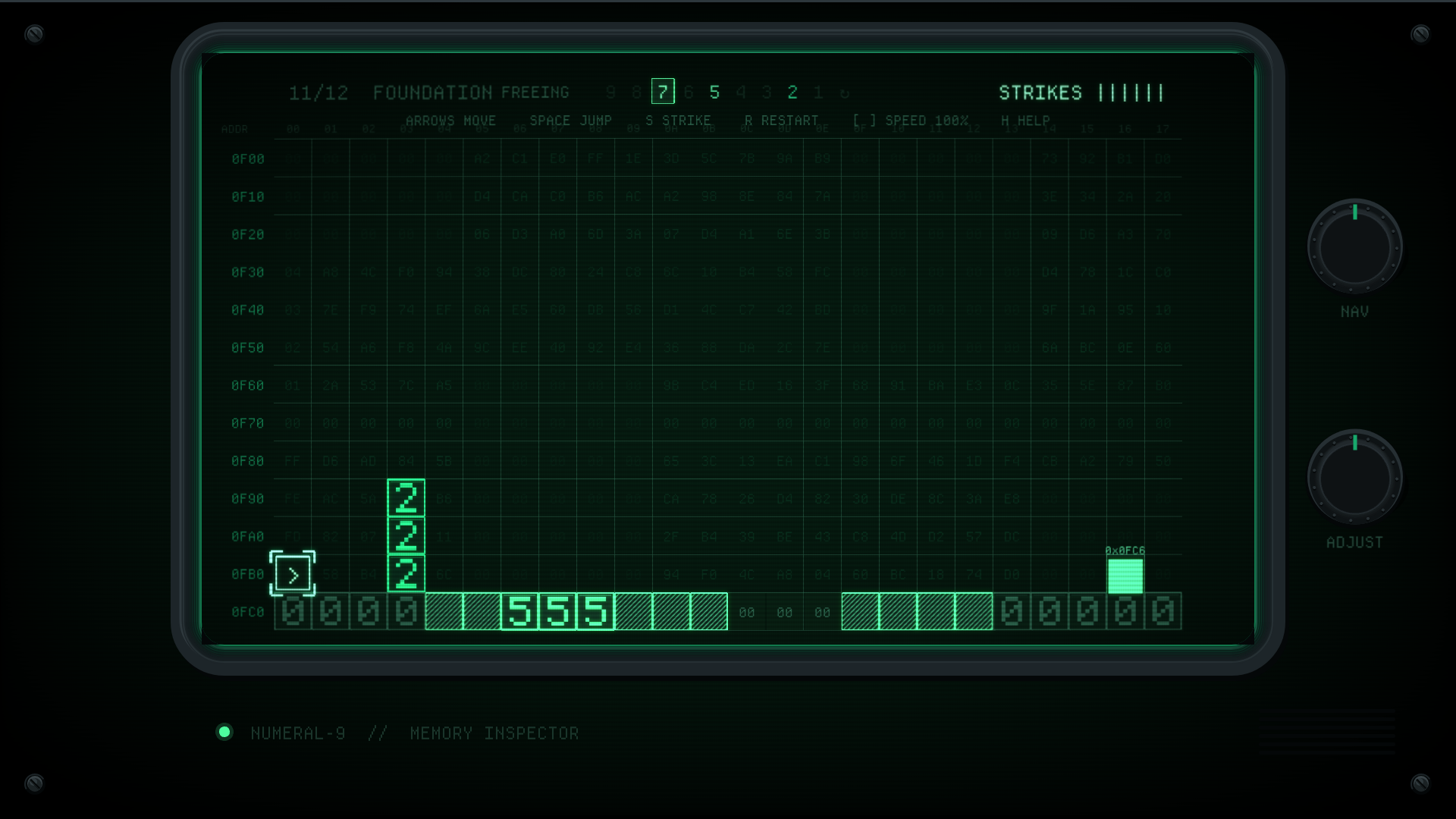
- A counter counts down: 9, 8, 7 … 1. About one second per number. It runs along the top of the screen, so you always know where it is.
- When the counter reaches a floor's number, that floor is deleted. A floor marked 9 goes first. A floor marked 1 is nearly the last thing standing.
- At 1, everything comes back and it starts over. A full loop is about eight seconds. The world rebuilding is normal — it is not a failure.
- The counter cannot kill you. Only falling off the bottom and touching a hazard can. Everything else is just the floor moving.
- Later on you get STRIKES. Stand next to a tile and press
S: its number drops by one. A lower number is called later, so striking a tile keeps it alive longer. Strike it all the way to 0 and the counter can never call it — the counter only speaks 9 through 1. That is the whole game.
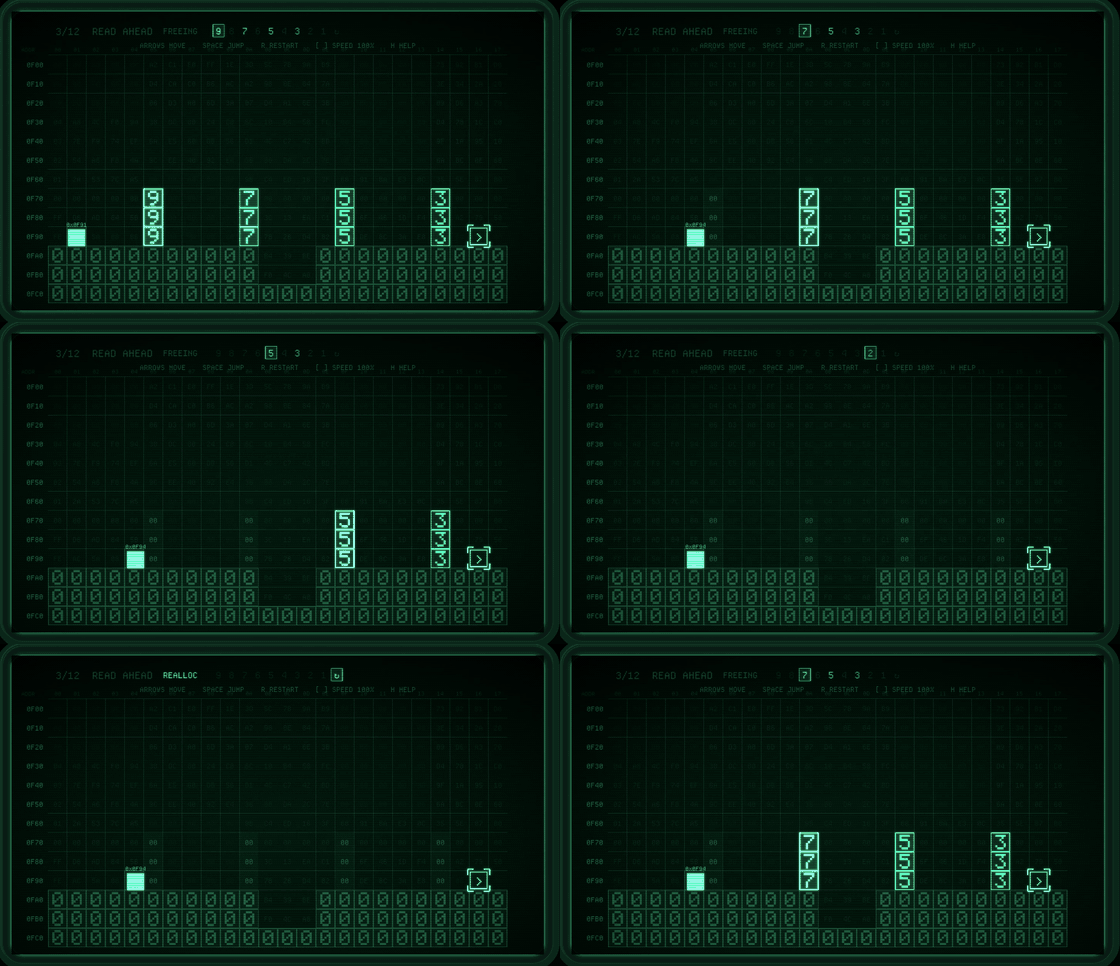
One full cycle. The pillars are called 9, then 7, then 5, then 3 — and then everything comes back.
Move with the arrow keys, jump with space, strike with S. Full list further down. If it feels fast, press [ to slow the whole count down — it goes to half speed and nothing else changes.
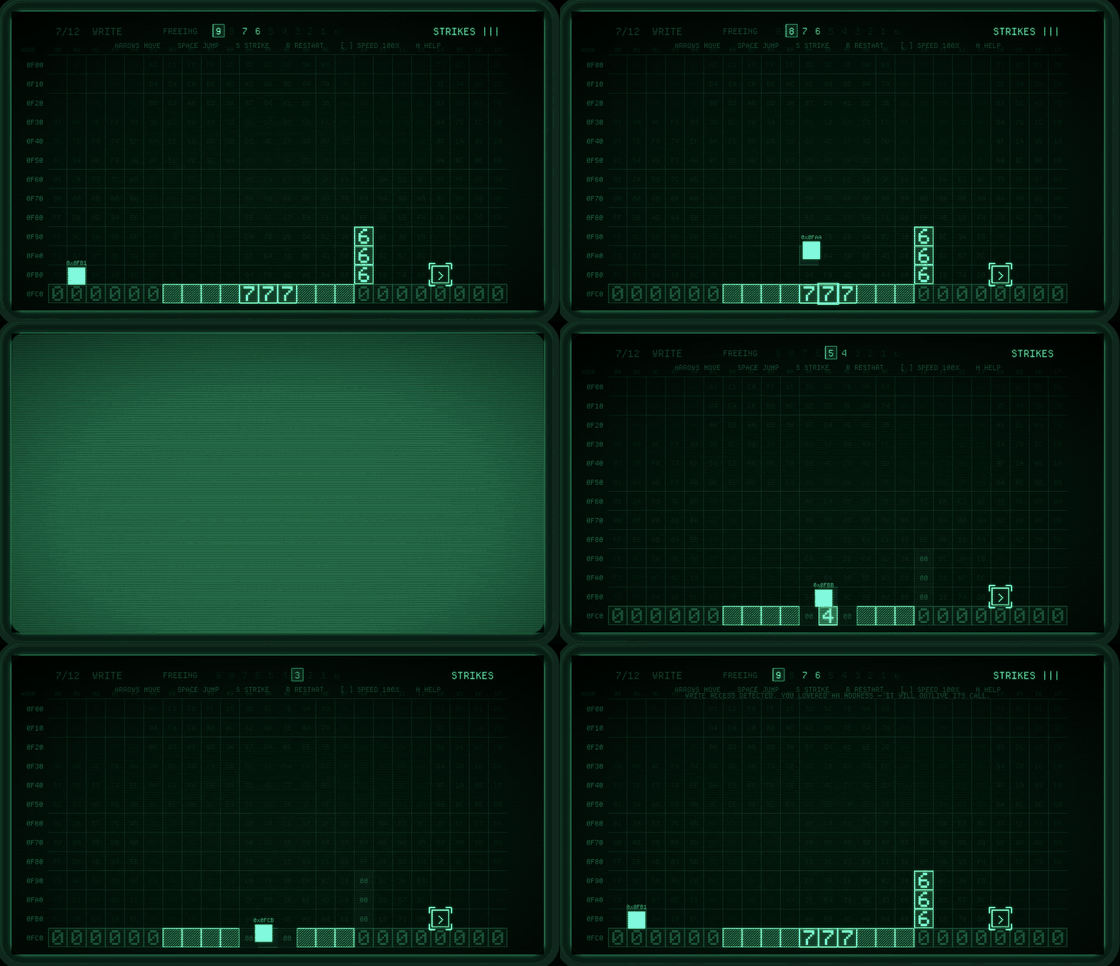
The strike. Every press takes the number down one — and a lower number is called later, so the tile lives longer. But be aware - if it's not a 0, then it will vanish after the countdown, so you have to jump to a safe place.
Things To Look Out For
- Don't rush. Nothing moves until you do. The counter does not start until your first step, so standing still and reading the room costs you nothing, ever.
- Don't panic when a floor vanishes. It always comes back. Nobody has ever been killed by the count — you can stand somewhere safe and watch a whole loop go by to learn the room.
- Don't trust a 9. High numbers die first. If you need a platform to still be there in five seconds, you want a low number under your feet.
- Don't hoard your strikes. Your charges refill every time the world rebuilds. Spending is renewable
- A wall is a door. A stack of numerals too tall to jump isn't a dead end — it's a door that opens on the beat that calls its digit. If you're stuck, read the number on the wall and wait for it.
The Story
The machine is shutting itself down, and it is being tidy about it. Sector nine is released first, then eight, then seven, working its way down to nothing. It has no reason to check whether anything is still living in there.
You are. You're a process nobody remembered to close, standing on memory that is being handed back a block at a time. You can't argue with the collector, and you can't outrun it — it isn't chasing you. It's simply arriving, on schedule, everywhere at once.
So you learn its schedule. And then, somewhere in the middle of all that, you learn to write.
The machine notices. It starts talking, one line at a time at the top of the screen, and the voice changes as you go: first a clerk reading out a log, then something that has found a discrepancy it cannot account for, then something asking you a question.
AN ADDRESS AT ZERO WILL NOT RELEASE. WHY WILL IT NOT RELEASE.The last room has no way out. Everything else has already been released. The only address left in the world is the one under your feet.
No cutscenes, no dialogue, no character art. The log is the only voice in the game.
How The Theme Is Used
The theme is COUNT DOWN. I read it not as a clock running out, but as counting downward through objects.
The world's countdown destroys — it calls a digit and takes every tile wearing it. Your countdown preserves: the strike lowers a tile's digit, a lower digit is called later, so counting a thing down buys it life. Take it all the way to zero and it leaves the count forever, because the counter only ever speaks 9 through 1. Zero is not a number it knows how to say. In a world that deletes itself on a loop, counting something down to nothing is the only way to make it permanent.
The same counter also opens things. A numeral wall too tall to jump can't be passed until the beat that calls its digit erases it — so the countdown is what lets you through as much as it is what takes the floor out from under you. Destruction becomes something you wait for and time.
And it is what the last level is made of. There is no exit; there is one address left, and it is yours.
Accessibility
The screen is monochrome green phosphor, and heat is brightness — never hue. A 9 is near-white hot, a 1 is dim and cold, a 0 is dead stone. The game is colourblind-safe by construction; there's no separate colourblind mode because there was never a second channel to fail. The digit is the primary channel throughout, so the game is fully playable in pure greyscale with zero information loss.
Every state change speaks on at least two channels — flash and brightness, number and sound. The count waits for your first move, so planning is never timed. Assist speed ([ / ]) slows every beat to as little as half speed, and every level is solvable at the slowest setting. Reduce-motion is honoured everywhere motion carries meaning. Restarts are instant.
Built With
Phaser 4, TypeScript, Vite.
The CRT look — curvature, scanlines, beam, glass wash, vignette — is one custom fragment shader applied in a single pass over the whole screen. There is no external art: the numerals are a hand-authored 5×7 bitmap font drawn at boot. There are no sound files; all audio is synthesised at runtime. UI font is Departure Mono (CC0).
AI Disclosure
This game was built with Claude Code as a pair programmer.
Leave a comment
Log in with itch.io to leave a comment.